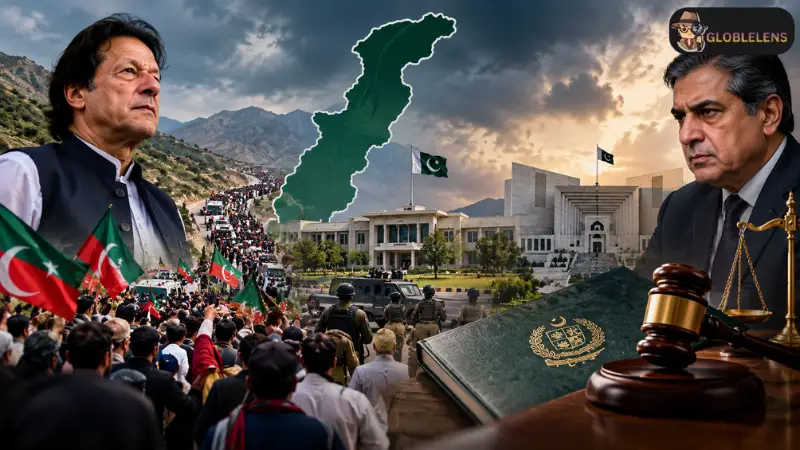
The political landscape of Khyber Pakhtunkhwa (KP) stands on a precipice as tensions between the federal administration and the provincial leadership intensify. The potential imposition of Governor’s Rule in the province has transformed from a subtle political threat into a high-stakes standoff. Central to this friction is the ongoing long march led by Pakistan Tehreek-e-Insaf (PTI) regional leadership, navigating through Karak towards Swabi and ultimately Islamabad. The movement has drawn significant public participation across various southern districts, creating acute administrative anxiety in Islamabad.
Federal authorities, represented prominently by Interior Minister Mohsin Naqvi, have cited potential violations of judicial orders and Section 144 restrictions as grounds for strict state intervention. The federal narrative frames the long march as an unconstitutional attempt to undermine state authority and disrupt public order. Suggestions of applying constitutional provisions to suspend provincial autonomy have been voiced with increasing frequency. However, analysts point out that enforcing Governor’s Rule in KP carries profound political risks for the central government and the security establishment.
Historically, suspending elected provincial assemblies in Pakistan has rarely yielded political stability. The situation in KP is further complicated by the high level of public mandate held by the ruling party in the province. Removing or sidelining provincial leadership through executive decree risks creating a political vacuum. Rather than suppressing public agitation, such measures often shift discontent from political channels directly onto the streets. The political cost of alienating a province with strong regional identity and distinct security challenges could lead to prolonged instability.
Legal experts highlight that imposing Governor’s Rule requires strictly defined constitutional criteria, primarily the breakdown of constitutional machinery within the province. Opponents argue that political demonstrations and disagreements over counter-terrorism policies do not automatically fulfill these conditions. Any executive order suspending provincial authority is virtually guaranteed to face immediate and rigorous challenges in the apex court. The judicial scrutiny following such a move would test the limits of executive power versus constitutional federalism.
From a strategic perspective, the political impasse poses a dilemma for all stakeholders. The confrontation diverts state focus and resources away from pressing security concerns in the border region. A protracted constitutional conflict between Islamabad and Peshawar risks deepening institutional divides at a critical junction for regional security. Political observers emphasize that sustainable governance in volatile regions relies on political accommodation rather than heavy-handed executive measures.

