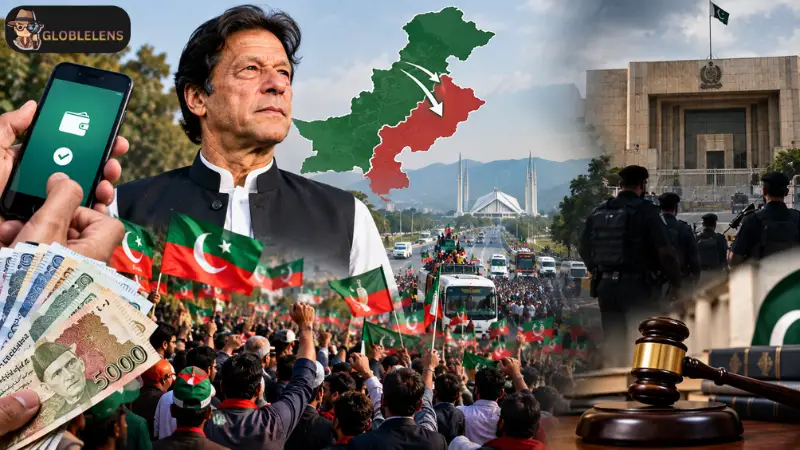
Political financing in Pakistan is undergoing a major structural shift as opposition movements adapt to institutional pressure and restricted operational environments. The Pakistan Tehreek-e-Insaf (PTI) has initiated a grassroots public fundraising campaign to support its multi-day protest movement scheduled to run from September 25 through October 5. Operating while founder Imran Khan remains incarcerated, the party leadership is appealing directly to the domestic populace and overseas diaspora for financial backing to sustain long-term street demonstrations.
Political campaigns require significant capital to manage logistics, transport, food, accommodation, and communication setups for hundreds of thousands of participants over extended periods. Traditionally, political entities rely on wealthy patrons, corporate donors, or state patronage. However, PTI's public strategy relies on micro-donations, requesting amounts as small as PKR 100 per individual via digital wallets like EasyPaisa and direct bank accounts. Mathematically, if ten million citizens contribute small increments, the total fund easily crosses one billion rupees. This approach serves a dual operational purpose: generating liquid financial capital while actively deepening the psychological and financial commitment of individual supporters.
The success of this mobilization hinges on regional dynamics, specifically between Khyber Pakhtunkhwa (KP) and Punjab. Khyber Pakhtunkhwa serves as the operational base where PTI holds provincial governance, providing the party with the organizational capacity and physical momentum required to initiate large-scale marches toward the capital. However, political analysts note that while KP generates initial momentum, the political outcome of any movement targeting Islamabad is ultimately decided in Punjab.
Punjab represents the country's political core and holds the highest concentration of parliamentary seats. The provincial administration in Punjab has maintained a heavy security posture, conducting intelligence-led operations, house raids, and preventative detentions targeting opposition networks to prevent mass assembly. This high level of law enforcement resistance creates an asymmetrical dynamic: KP forces the opening of physical conduits toward the federal capital, while supporters in Punjab face severe law enforcement resistance to join the assemblies.
Simultaneously, legal battles continue to shape the boundaries of political assembly. Following restrictive orders from the Islamabad High Court regarding protest permissions, PTI leadership announced plans to challenge the rulings in the Supreme Court of Pakistan through the Advocate General of Khyber Pakhtunkhwa. Legal strategists advise against making the political party itself a direct petitioner to avoid procedural delays or binding status-quo orders that could stall political momentum. Bypassing state administrative controls through constitutional petitions remains a core tactic for maintaining the legality of long-distance marches.

