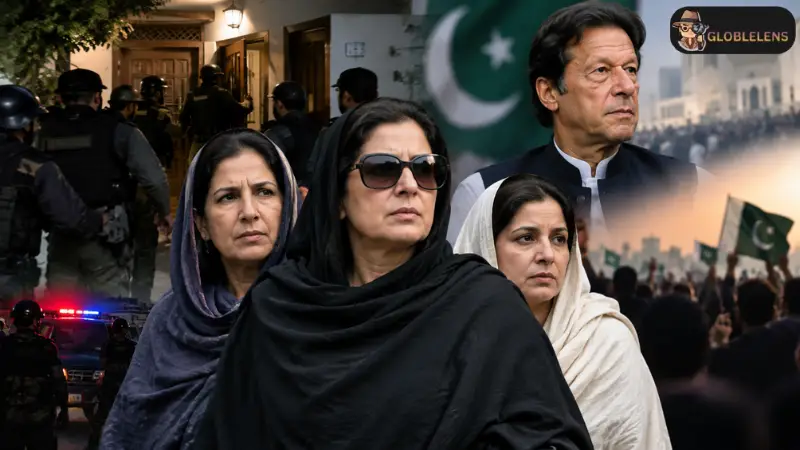
The political landscape in Pakistan has reached an unprecedented boiling point following the aggressive late night police raids and subsequent arrests of the sisters of former Prime Minister Imran Khan. The detentions of Aleema Khan, Uzma Khanum, and Noreen Niazi under the Maintenance of Public Order (3 MPO) ordinance represent a severe escalation in the ongoing conflict between the state apparatus and the Pakistan Tehreek e Insaf leadership. This move shifts the paradigm of political victimization by directly targeting family members to apply immense psychological and political pressure on the incarcerated leader.
The operation itself was executed with overwhelming force. Law enforcement personnel cordoned off a massive perimeter around Aleema Khan's residence and physically broke down doors to gain entry. The sweep was not limited to the high profile sisters. It extended to nephews, extended family members, and even domestic staff. Such sweeping actions suggest a deliberate strategy to create an environment of fear and total vulnerability. By capturing the entire familial support system, the state aims to isolate the political leadership completely.
Strategically, this crackdown appears to be a preemptive strike to paralyze the opposition's mobilization efforts. With a major protest march looming just days away, dismantling the core logistical and familial network serves as a clear warning to potential agitators. The use of the 3 MPO ordinance, a law originally designed to prevent individuals from acting prejudicially to public safety, is increasingly being leveraged as a blanket tool for political suppression. This legal maneuvering allows authorities to bypass standard judicial procedures and hold individuals without formal criminal charges for extended periods.
A glaring aspect of this entire episode is the deafening silence from civil society, human rights organizations, and rival political factions. Historically, aggressive state actions against female political figures or their families have drawn severe condemnation across the political spectrum. Past incidents involving female politicians from rival parties triggered national outrage and immediate interventions from human rights advocates. The current apathy exposes a deeply polarized society where human rights are championed selectively depending on political affiliations. This selective outrage undermines the very foundation of democratic norms and civil liberties in the country.
Furthermore, these detentions indicate a systemic shift in how political engineering is conducted in Pakistan. The traditional methods of arresting direct political opponents have evolved into a scorched earth policy that leaves no relative untouched. The objective is clearly to force the political opposition into retracting its calls for nationwide agitation. By holding family members hostage to state machinery, the authorities hope to extract concessions that political negotiations failed to achieve.
This approach of dragging non political family members into the fray risks alienating the public even further. When citizens observe the state utilizing heavy handed tactics against women and domestic workers, the legitimacy of the ruling establishment suffers a severe blow. The historical context of Pakistan’s political evolution shows that suppressing dissent through sheer force often yields temporary compliance but breeds long term resentment. The public perception is rapidly shifting from viewing these events as mere political rivalries to recognizing them as systemic abuses of power. As the economic and social fabric of the country remains fragile, such intense political instability only exacerbates the nation's crises. International observers are also likely to view these detentions as a significant departure from democratic principles, potentially impacting foreign relations and economic assistance. The path forward remains perilous as the state apparatus continues to rely on coercion rather than political reconciliation to manage its domestic challenges.

