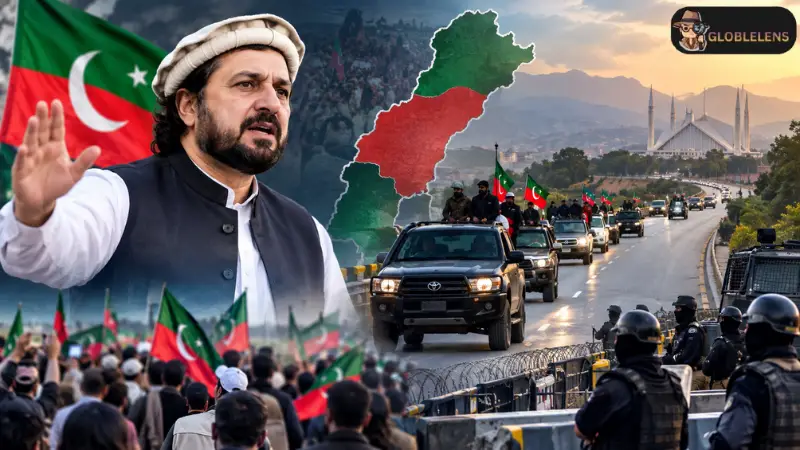
Pakistan’s current political landscape remains locked in intense friction as Pakistan Tehreek-e-Insaf (PTI) recalibrates its operational strategy to navigate state opposition across Punjab. At the center of this structural realigning is Chief Minister Khyber Pakhtunkhwa Sohail Afridi, whose updated strategy aims to bypass police blockades and administrative crackdowns to re-establish the party’s public footprint in the country's most populous province.
For months, the provincial administration in Punjab has maintained a heavy security grid around major urban centers like Lahore and Rawalpindi. Section 144 restrictions, pre-emptive detentions of local organizers, and heavy road barriers have disrupted conventional public rallies (jalsas) and protest marches. Recognizing the diminished returns of traditional street mobilization under strict security protocols, Sohail Afridi and the central leadership have opted for a decentralized, highly mobile tactical approach.
The cornerstone of the new plan relies on decentralized convoys (caravans) originating from Khyber Pakhtunkhwa and rural Punjab, converging dynamically rather than committing to fixed rally venues in advance. By maintaining fluid movement, the leadership aims to stretch security deployments across multiple transit routes, mitigating the risk of mass containment at single entry checkpoints. Furthermore, local district-level units are being tasked with organizing localized, pop-up demonstrations to keep administrative machinery active without exposing top-tier leaders to immediate mass arrests.
This tactical shift reflects a broader acknowledgment within PTI that static power projection is no longer viable against coordinated state apparatuses. Instead, continuous movement, high-frequency digital coordination, and regional pressure tactics are being prioritized. However, significant challenges remain. Transport logistics, intra-party coordination across provincial borders, and the persistent threat of police action continue to test the sustainability of this strategy. Whether this realigned momentum can pressure the ruling coalition into political concessions depends heavily on how effectively local networks execute these decentralized maneuvers in the weeks ahead.

