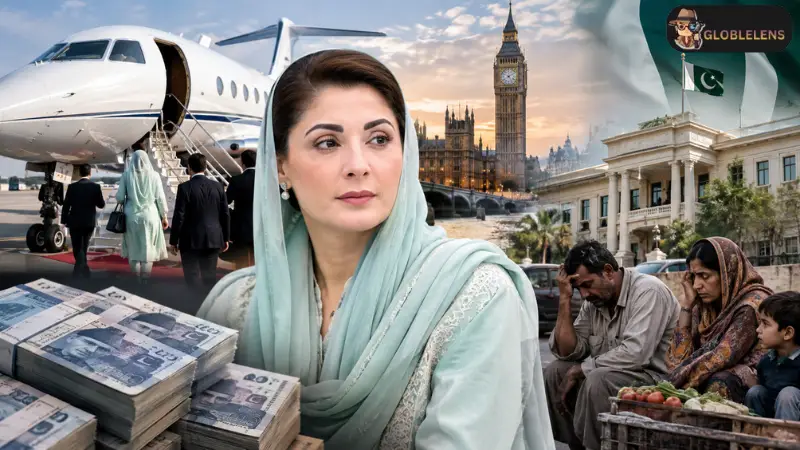
The debate surrounding political privilege and public accountability in Pakistan reached a boiling point following revelations regarding Chief Minister Maryam Nawaz Sharif's utilization of the Punjab government's official aircraft. The controversy centers on the acquisition and deployment of a high-value Gulfstream GVII-G500 executive jet, purchased by the provincial administration for approximately 11.7 billion Pakistani rupees (over 42 million USD). Political commentators, including veteran journalist Imran Riaz Khan, have scrutinized both the initial expenditure on the luxury asset and its subsequent operational usage for non-official travel.
The core dispute ignited when reports confirmed that Chief Minister Maryam Nawaz utilized the state-owned jet for a private trip to London to attend her daughter's graduation ceremony. Opponents from the Pakistan Tehreek-e-Insaf (PTI) and Jamaat-e-Islami (JI) immediately condemned the travel, arguing that allocating state infrastructure for personal milestones reflects systemic detachment from Pakistan's prevailing economic crisis. Critics pointed out the striking irony of spending billions on executive aviation while essential sectors face fiscal cuts and national assets like Pakistan International Airlines undergo privatization drives.
In response to mounting public backlash, Chief Minister Maryam Nawaz publicly addressed the allegations during an event in Multan. She defended the purchase of the aircraft, clarifying that the asset belongs to the Chief Minister's office rather than her personal estate. To mitigate concerns regarding misuse of public funds, she asserted that she reimbursed the provincial treasury approximately 27.5 million Pakistani rupees (2.75 crore PKR) out of her own pocket to cover the fuel, operational, and parking expenses incurred during the private foreign flight. Official government representatives echoed her statement, insisting that no taxpayer money was compromised for personal gain.
Despite the formal reimbursement, political analysts and legal observers contend that the issue extends beyond simple financial restitution. Questions linger regarding the methodology used to calculate flight overheads, the transparency of official documentation, and the legal framework governing the private chartering of state equipment by public office holders. While the provincial administration frames the payment as proof of institutional ethics, opposition figures view the transaction as a reactive measure designed to suppress an escalating political scandal.
Beyond the immediate aviation controversy, the saga highlights broader systemic concerns regarding state spending, VIP culture, and governance priorities in Punjab. With millions of citizens grappling with inflation, poverty, and inadequate public infrastructure, the optic of executive luxury travel creates a severe narrative challenge for the ruling PML-N leadership. As opposition parties leverage the controversy to mobilize public sentiment ahead of political rallies, the debate over administrative accountability and public asset management remains a volatile focal point in Pakistan's political landscape.

