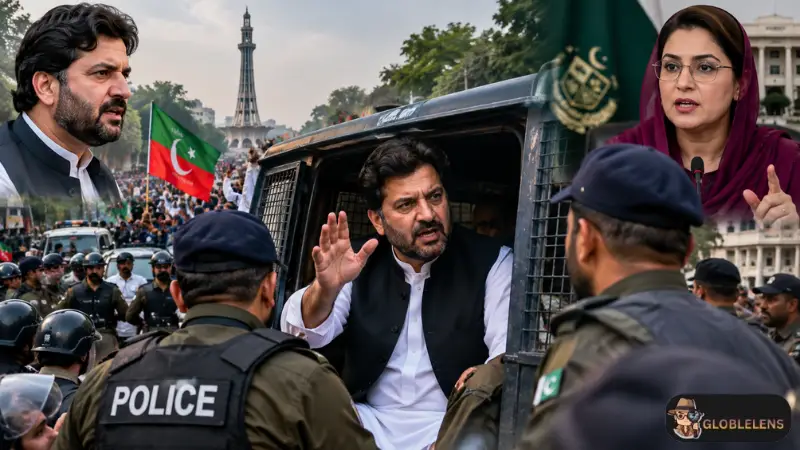
Political friction between Pakistan Tehreek-e-Insaf (PTI) and the federal-backed Punjab administration reached a critical boiling point following a high-voltage confrontation involving Khyber Pakhtunkhwa Chief Minister Sohail Afridi in Lahore. The incident unfolded after law enforcement authorities intercepted a political convoy and took several key party officials into custody, including PTI District Lahore President Mian Akram Usman and Vice President Mehr Naeemullah Taj.
The escalation occurred during a planned political visit to Punjab, intended to rally momentum for an upcoming nationwide protest movement scheduled for late September. In response to the detainment of his party colleagues, Chief Minister Sohail Afridi staged a symbolic protest by voluntarily boarding a police prisoner van, refusing to vacate until the arrested workers were released. The bold move created immediate procedural and legal paralysis for local law enforcement, as officers struggled to handle a sitting chief executive inside police custody.
After an extended standoff near major thoroughfares in central Lahore, police eventually drove the vehicle to Lakshmi Chowk, where Afridi was dropped off amidst a growing crowd of supporters. Addressing media representatives and gathered citizens, Afridi alleged that law enforcement personnel attempted to unlawfully detain a sitting chief minister, warning that such measures undermine federal stability and set a dangerous precedent for inter-provincial relations. He asserted that his presence in Lahore was that of an ordinary Pakistani citizen exercising constitutional freedoms rather than an aggressive political invasion.
Conversely, representatives of the Punjab government dismissed the episode as a calculated publicity effort. Punjab Information Minister Azma Bokhari publicly released footage of the incident, claiming that Afridi voluntarily entered the vehicle against the advice of both police personnel and his personal security staff. Government spokespersons argued that law enforcement was maintaining public order ahead of unpermitted political rallies, characterizing the chief minister's actions as an attempt to provoke state institutions and manufacture media coverage.
This high-profile confrontation highlights deeper institutional fractures within Pakistan's political structure. As opposition parties test the boundaries of provincial sovereignty and public assembly, the standoff in Lahore signals an increasingly hostile landscape where administrative protocols and political posturing directly compete for authority.

