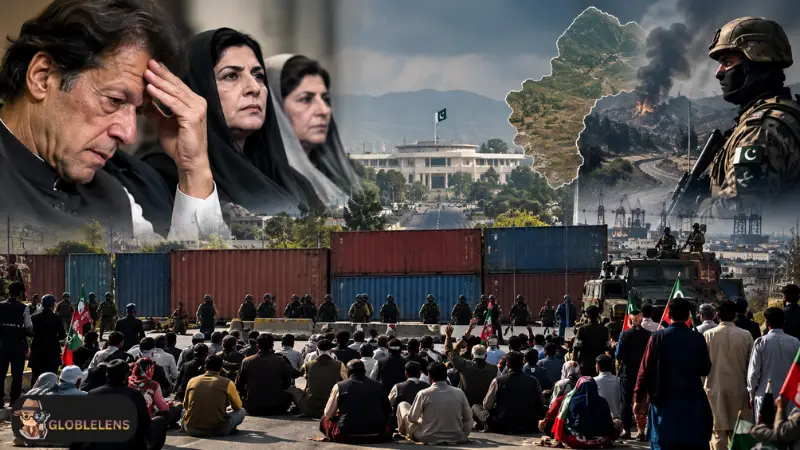
The political landscape of Pakistan has reached an unprecedented level of volatility. The ruling administration is currently exhibiting signs of severe distress and panic as it attempts to manage an increasingly resilient opposition. The visual evidence is clear across the nation. Capital cities are being severed from provinces through the extensive deployment of shipping containers. Widespread arrests and systemic human rights violations have become the norm. The opposition is effectively utilizing these extreme government measures to broadcast the fragility of the current regime to the global community.
Historically, political scientists and historians have noted that regimes lacking organic democratic legitimacy often resort to extreme measures of suppression. A parallel can be drawn to colonial eras where occupying forces heavily marginalized the previous ruling class to consolidate power. The current establishment in Pakistan appears to be applying a similar playbook against the ousted political leadership. This aggressive suppression stems from a deep seated fear of losing control over a rapidly deteriorating national situation.
The internal security and economic indicators of Pakistan paint a grim picture. Balochistan is grappling with severe instability, leaving even heavily guarded cantonments vulnerable. The tribal belts of Khyber Pakhtunkhwa are witnessing a resurgence of violence. Karachi, the economic engine of the nation, is facing severe administrative collapse, while Punjab experiences unprecedented crackdowns on civil liberties. Concurrently, the economic infrastructure has completely stalled, effectively deterring any potential foreign investment. The combination of these factors has created a pressure cooker environment with no immediate pressure release valve in sight.
A highly strategic element of the ongoing crisis involves the targeted arrests of the sisters of the former Prime Minister. These individuals have historically served as a critical line of defense against internal compromises within the opposition party. They hold immense sway over the party workers and are known to publicly veto any backroom deals that contradict the core ideology of their brother. Their incarceration is widely viewed as a calculated move by the establishment to silence the most trusted voices of the opposition base. This temporary vacuum allows certain compromised elements within the party leadership the space to potentially negotiate terms that would otherwise be immediately rejected by the grassroots supporters.
In response to the fortified capital, the opposition has fundamentally altered its protest strategy. Moving away from predictable time bound marches that target specific locations, the movement has adopted a highly flexible strategy of attrition. The new approach centers on patience and decentralization. Protesters are mobilizing from diverse routes and planning to converge at strategic points like Swabi. The tactical directive is simple but effective: if security forces block a route, the protesters will simply sit down at that exact location.
This sit in strategy shifts the logistical and political burden entirely onto the government. By refusing to engage in direct clashes and instead occupying the blockades created by the state, the opposition is forcing the government to maintain a costly and paralyzing security apparatus indefinitely. Schools are closed, highways are blocked, and daily life is disrupted, all at the hands of the state itself. The longer the government maintains these container walls, the more it damages its own credibility and administrative functionality.
Desperate voices within the ruling coalition are now advocating for the imposition of Governor Rule in Khyber Pakhtunkhwa. Political analysts view this as a potentially catastrophic miscalculation. Taking direct control of a highly mobilized and aggrieved province would invariably backfire, placing the blame for every subsequent administrative and security failure directly on the federal government and the military establishment. The crisis requires a return to democratic mandates rather than further authoritarian centralization.

