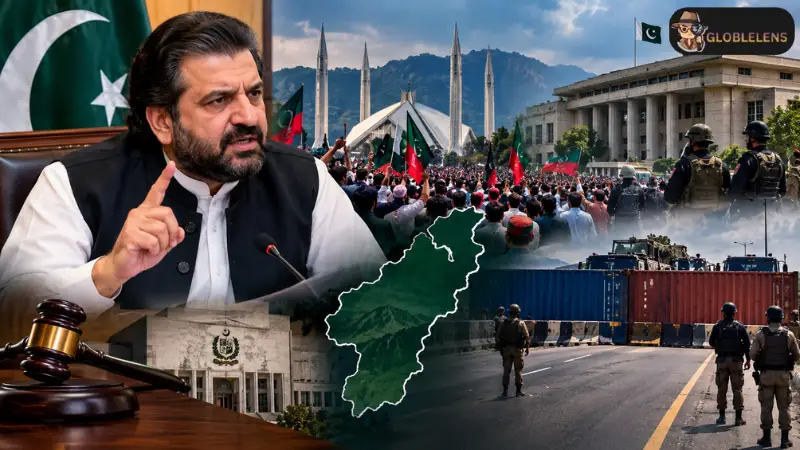
The political climate in Pakistan has reached a critical flashpoint as Khyber Pakhtunkhwa Chief Minister Sohail Afridi openly rejects federal pressure and deadlines regarding planned protest demonstrations in Islamabad. The central government and security establishment have intensified scrutiny on the provincial leadership, warning of severe legal and administrative consequences if state resources are utilized to mobilize political rallies toward the federal capital. Despite these warnings, CM Afridi has reaffirmed the administration's resolve to proceed with the planned October 4 Long March, creating an unprecedented administrative deadlock between the center and the province.
The core of the dispute centers on the federal government's insistence that provincial Chief Ministers remain within constitutional bounds and refrain from utilizing provincial machinery for partisan political mobilization. Reports indicate that federal authorities issued an ultimatum demanding clear guarantees against the blocking of national highways and the storming of federal zones. In response, Chief Minister Afridi publicly defied the deadline, arguing that peaceful protest is a fundamental constitutional right guaranteed under the Constitution of Pakistan.
This operational stance has elevated fears of a complete administrative breakdown between Peshawar and Islamabad. Federal interior officials have hinted at several countermeasures under consideration, ranging from financial constraints on provincial fund releases to the invocation of constitutional emergency measures. Key legal parameters surrounding Governor’s Rule under Article 234 of the Constitution are being actively debated in political and legal circles. Article 234 allows the President, upon receiving a report from the Governor, to assume provincial administrative functions if the provincial government cannot be carried out in accordance with the provisions of the Constitution. However, enforcement of Governor’s Rule carries significant political risks, potentially further alienating the populace in Khyber Pakhtunkhwa and heightening regional instability.
Simultaneously, law enforcement agencies across Punjab and the Islamabad Capital Territory have initiated precautionary security measures, setting up shipping containers along key entry points and highways connecting KP to Punjab. The provincial leadership in Peshawar views these measures as an infringement on movement and provincial autonomy. Analysts note that CM Afridi’s confrontational approach marks a structural shift in PTI's strategy, positioning Khyber Pakhtunkhwa as the central staging ground for anti-government resistance while maintaining a firm hold on provincial power.
As the October 4 deadline approaches, both the federal coalition and the provincial government remain locked in a game of political brinkmanship. The lack of active backchannel dialogue or institutional conciliation suggests that the coming days will serve as a crucial test for federalism, judicial oversight, and operational crisis management in Pakistan.

