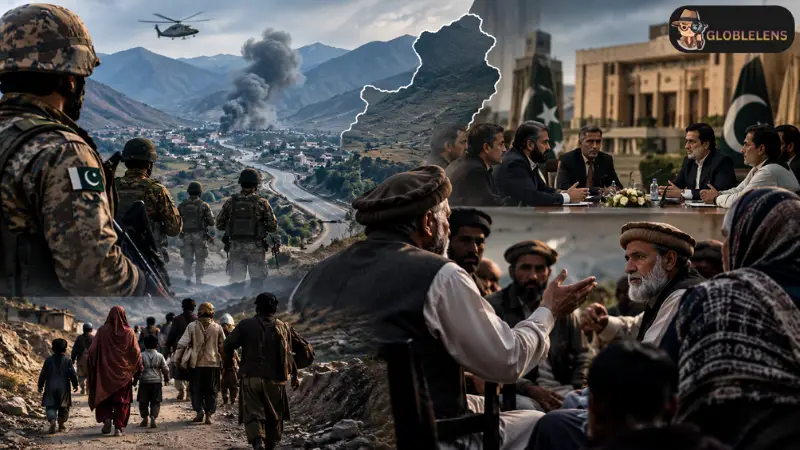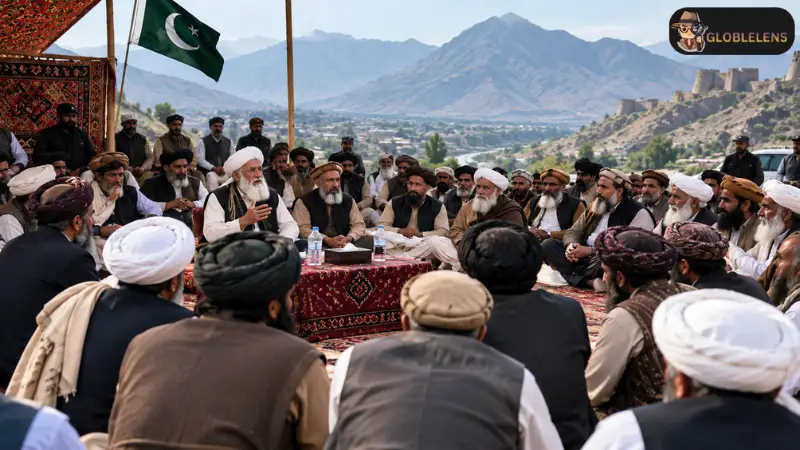
In response to rising political confrontation and deteriorating security conditions across Khyber Pakhtunkhwa, tribal elders and community leaders have convened a massive 100-member Grand Jirga. This traditional assembly seeks to serve as a mediating force between the provincial government, local political factions, federal security agencies, and regional tribal leadership. The mobilization of traditional conflict-resolution mechanisms highlights the deep-seated concern among local populations regarding political instability and security operations in the province.
The Jirga framework has historically served as a critical decision-making institution in the Pashtun belt, bridging formal state apparatuses and local community governance. The current assembly aims to address multiple compounding challenges, including heightened security operations in border areas, civil-military friction, and the economic strain caused by recurrent road blockades and regional instability. Tribal representatives emphasized that continuing administrative clashes between Islamabad and Peshawar directly harm local populations, paralyze business operations, and create governance vacuums.
Central to the Jirga's mandate is establishing a structured mediation channel to avert direct violent confrontations between law enforcement agencies and political workers during upcoming protest marches. Elders involved in the initiative have initiated preliminary discussions with provincial officials in Peshawar as well as civil society leaders. The primary objective is securing commitments to prevent force while ensuring that local law and order is maintained without militarizing public spaces.
Furthermore, the Grand Jirga is expected to present a unified charter of demands addressing localized security grievances. These include demands for greater transparency regarding security operations, protection of civilian livelihoods, and restoration of uninterrupted trade routes across key border passes. Security analysts observe that while traditional Jirgas carry significant moral authority within the province, their success in de-escalating political conflicts depends heavily on the willingness of both federal authorities and provincial political actors to engage in genuine dialogue.
The activation of this 100-member Jirga underscores a growing realization within Khyber Pakhtunkhwa that institutional legal frameworks and partisan politics are failing to maintain stability. By asserting tribal arbitration, regional leaders are working to insulate local communities from national political volatility and prevent a further breakdown of public order.