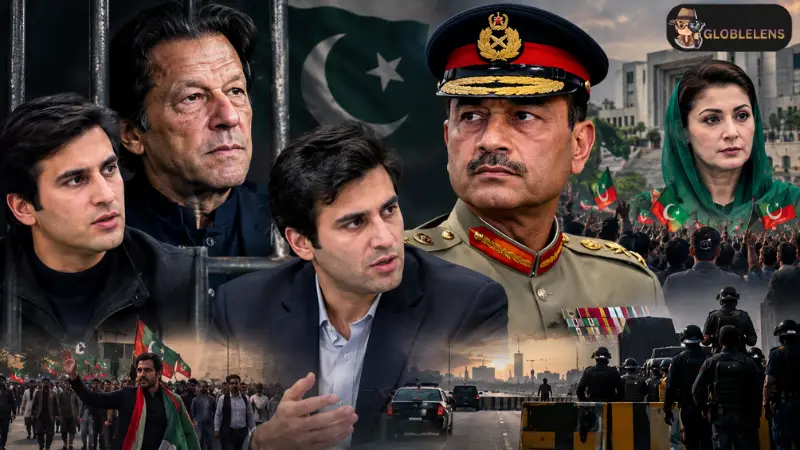
The international political arena surrounding Pakistan has taken a dramatic turn following direct allegations made by Kasim and Sulaiman Khan, the sons of incarcerated former Prime Minister Imran Khan. Speaking in an exclusive interview with the British newspaper The Guardian, the two London-based sons explicitly accused Pakistan’s Chief of Army Staff, General Asim Munir, of orchestration and personal retribution. They alleged that their father is being subjected to harsh, slow isolation designed to deliberately deteriorate his health and well-being while in custody, comparing his situation to historical precedents of state-led political elimination in the region.
This development marks a significant escalation in the ongoing confrontation between the military establishment and the leadership of Pakistan Tehreek-e-Insaf (PTI). Historically, immediate family members residing abroad maintain a lower public profile; however, this public declaration signals a shift toward international legal and diplomatic pressure. By naming the head of the military directly, the opposition movement aims to bring global oversight to the treatment of political prisoners in Pakistan, directly targeting the international reputation of the armed forces leadership.
On the domestic front, political friction continues to paralyze state institutions. Allegations have surfaced regarding the role of Punjab’s political administration, under Chief Minister Maryam Nawaz, working in close coordination with state security agencies. Critics argue that state machinery, police forces, and intelligence personnel have been deployed to restrict civil liberties, breach privacy, and stifle political opposition across the province. Analysts point to these actions as part of an aggressive push to curb public mobilization and restrict opposition gatherings ahead of planned political rallies.
Despite heavy security presence, road blockades, and police crackdowns, political figures like Khyber Pakhtunkhwa Chief Minister Sohail Afridi have attempted to cross provincial lines into Punjab to gauge public sentiment. His unannounced movements through key urban centers like Lahore and Sialkot were designed to bypass police cordons and assess street-level support. While state authorities attempted to control crowd sizes through localized detentions, internet disruptions, and power outages in targeted districts, local receptions in places like Sialkot demonstrated persistent public engagement among youth and political activists.
The strategic deadlock between the political opposition and the military establishment highlights a fundamental asymmetry in resources and time. The military apparatus relies on finite institutional budgets, heavy security deployment, and temporary legislative measures to maintain control, making long-term containment logistically and economically taxing. Conversely, opposition strategists lean on popular numbers, mass public fatigue, and long-term civil resistance. With major protest calls scheduled for late September, both sides appear locked in a battle of endurance where political stability remains distant.

