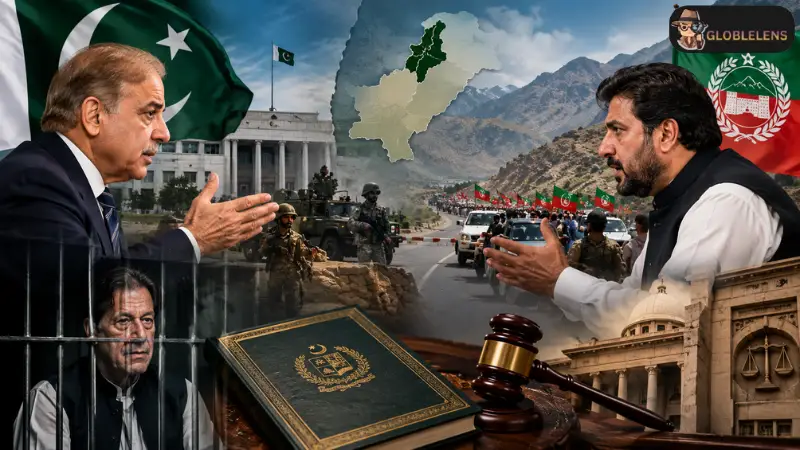
The operational friction between Pakistan's federal government and the provincial administration of Khyber Pakhtunkhwa highlights deep institutional deadlocks within the country's governance framework. As political mobilizations organized by opposition forces move along provincial highways, the broader debate has shifted from political discourse to constitutional authority, law enforcement boundaries, and provincial autonomy.
At the core of the immediate dispute is a fundamental misalignment on regional security governance and anti-terrorism policies. During recent negotiations between federal representatives and provincial delegates, federal officials emphasized that provincial leadership must guarantee full alignment with federal security agencies regarding counter-terrorism operations in affected border regions. Conversely, provincial leadership in Khyber Pakhtunkhwa argued that existing security paradigms implemented over recent decades have yielded limited long-term stability, proposing instead a revised policy framework centered on local consensus and provincial authority.
This policy division has been further exacerbated by disputes surrounding the treatment and legal status of jailed opposition leader Imran Khan. Provincial officials have repeatedly cited concerns regarding Khan’s health conditions at Adiala Jail, demanding immediate access for independent medical examiners. Federal authorities maintain that detention conditions adhere to legal standards and accuse the provincial leadership of using judicial and medical requests as political leverage to bypass established legal procedures.
From a constitutional perspective, federal authorities have evaluated executive mechanisms to address potential operational challenges posed by the provincial government. Chief among these mechanisms is Article 234 of the Constitution of Pakistan, which grants the executive branch authority to issue a Proclamation of Governor's Rule in a province if the provincial government cannot function in accordance with constitutional provisions. Legal scholars note that while Governor's Rule provides a legal mechanism for federal intervention, its deployment risks heightening political volatility across the province.
The current institutional deadlock demonstrates the precarious balance between federal authority and provincial autonomy in Pakistan. As provincial leadership continues its public mobilization toward federal border points, both federal and provincial institutions face critical decisions that could alter the governance landscape and security posture of the region.

